


IELTS Listening Tips
July 1,2025
root
It’s a good idea to do practice tests (e.g. using the Cambridge IELTS books) in preparation for the listening exam. Here’s some advice to help you benefit from doing practice tests:
- Your score is not the most important thing
The important thing is what you have learnt by doing the test. Were there any new words or phrases that you can learn? What did you find difficult? Did any of the questions trick you? In other words, what do you need to do to improve your score?
- Check how accurate your answers are
Be strict with yourself; every grammar or spelling mistake is important. For example, if the speaker says “The library has a collection of newspapers“, you must not write “collection of newspaper“.
- Get into the habit of moving on
If you missed something, forget about it and move on. Always prepare for the next question rather than worrying about a previous question. When you are given 30 seconds to check your answers, use the time to look at the next section instead.
Often you don’t hear the exact words given in the question. Instead, you hear a synonym, a similar word, or an opposite. For example, if the question contains the word difficult, you might hear too hard or not easy.
Here’s a nice way to combine listening practice with topic research for the writing or speaking test:
- Choose a writing or speaking topic.
- Search for online videos on that topic.
- Note down any good vocabulary ideas that you see / hear in the videos.
For example, to get some ideas for the ‘genetic engineering’ writing topic, you can watch some videos on YouTube about this topic.
Candidates sometimes find it hard to decide whether an answer should be singular or plural, especially when they aren’t sure whether or not they heard the “s” on the end of a word.
Try the quick exercise below. For each sentence, decide whether we need the singular or the plural, or whether you think both would be acceptable.
- Bring two forms of ………. (identification, identifications).
- You may use your own ………. (pen, pens) in the exam.
- Please park between the ………. (line, lines).
- Entry is only permitted to registered ………. (student, students).
- The lecturer will leave plenty of ………. (time, times) for questions.
Are you doing the following things in order to prepare and practise for the IELTS listening test?
- working through as many of the tests in the official Cambridge IELTS books as possible
- doing the listening test samples on the official IELTS website
- analysing any mistakes that you make when doing the above tests
- listening to difficult parts of each test several times, until you hear and understand all of the correct answers
- checking the written transcripts (at the back of the Cambridge books) carefully for any questions that you found difficult
- noting new words and any spellings that you got wrong
- listening to as much English as possible to improve your ear (not just IELTS tests, but news reports, documentaries, talks, presentations, interviews, films, TV programmes etc. that you find on the Internet)
Here’s an easy way to check your spelling for the IELTS listening test:
- Find the listening test answers at the back of one of the Cambridge IELTS books.
- Record yourself reading the answers aloud (e.g. read the list below).
- The next day, listen to the recording and try to write the words down, with correct spelling.
- Check your answers.
For example, here are some of the listening answers from Cambridge IELTS 14. Record yourself reading this list, and then test your spelling tomorrow.
- furniture
- museum
- direction
- floor
- predictable
- fuel
- shoulder
- festivals
- comets
- instruments
- thermometer
- telegraph
- microphone
- exhibition
- carnival
- parade
- opera
- clarinet
- Olympics
- speech
- cabins
- tools
- heavy
- marble
- camera
Out of 25, how many words did you spell correctly?
Before you hear the recording, you have some time to read the questions and underline key words (the words that you intend to listen for).
Which key words would you underline in the questions below?
(from Cambridge IELTS 14)
Listen for the key words or synonyms
21. How will Rosie and Martin introduce their presentation?
- A with a drawing of woolly mammoths in their natural habitat
- B with a timeline showing when woolly mammoths lived
- C with a video clip about woolly mammoths
22. What was surprising about the mammoth tooth found by Russell Graham?
- A It was still embedded in the mammoth’s jawbone.
- B It was from an unknown species of mammoth.
- C It was not as old as mammoth remains from elsewhere.
Tip: Don’t underline words that are repeated in each choice (e.g. mammoth). Only underline the words that show you the specific differences between each answer choice.
Every time you listen to something in English, you have an opportunity to improve your vocabulary knowledge. You might hear a new word or phrase, or you might learn something about how a word is used.
This will lead to improvements when you’re learning a language. Keep your ears and eyes open and develop this noticing skill!
e.g: you may hear these collocations. You should add them to your vocabulary and use them.
- pay attention to something = take notice of something
- my mind wanders = I lost concentration
- take a nap = go to sleep for a short time
- drift off into a daydream = start thinking about something unrelated
- have the urge to do something = feel a strong desire to do something
Multiple choice questions in the listening test are always difficult. There are some reasons for that:
- There’s a lot of information in the question choices, so there’s a lot to think about while you’re listening.
- Some of the choices might be similar.
- All of the choices might be mentioned in some way.
- Synonyms or paraphrasing may be used instead of the words that you see in the choices.
Are you really working on your mistakes and learning from them?
Whenever you make a mistake in a practice test, you have the opportunity to make a small improvement. But this will only happen if you analyse the mistake carefully, comparing your answer with the correct answer in order to understand what went wrong.
Perhaps you made the mistake because of a particular word or phrase. Perhaps you misunderstood something, or missed a key detail because you were stuck on a previous question. Or perhaps you couldn’t keep up with the speed of the recording and the amount of information. If you want to make progress, you need to find out what the problem was.
Take the time to analyse your weaknesses and learn from them.
- Read the questions carefully to know how to write answers.
- For questions where the answers are letters or Roman numerals, you should write only the number of answers required. If you have written more letters or numerals than are required, the answers are marked wrong.
- Follow the word limit specified in the question. If you exceed this, your answer is wrong. E.g.
No more than 3 words – correct answer is “black leather coat”. The answer “coat of black leather” is incorrect.
- In the question where you are required to complete a gap, you should only write the necessary missing word(s) on the answer sheet.
e.g. “in the …” – the correct answer is “morning”. If you write “in the morning” – it’s incorrect.
- All answers require correct spelling. Both UK and US spelling are acceptable and are included in the answer key.
- Write the exact words you hear on the recording.
- If the symbols for currencies not given on the question paper, you will have to write it as part of your answer. Learn to write £, $, €. g.
- If you hear “nine pounds fifty” – write: £9.50
- All standard alternatives for numbers, dates and currencies are acceptable, but still you have to follow the word limit.
e.g. The thirtieth of November / 30th November / 30 November / November 30(th)
- All standard abbreviations are acceptable, e.g.:
50 kilograms / 50 kilogrammes / 50kg
100 meters/metres or 100 m
42 kilometres/kilometers or 42 km
- With answers that require you to write a word(s), be careful with singular and plural nouns. It has to be what it is said in the recording. Also, make sure the word you write fit in grammatically.
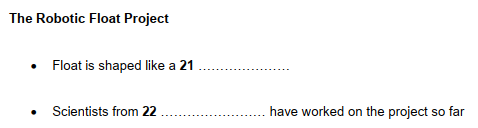
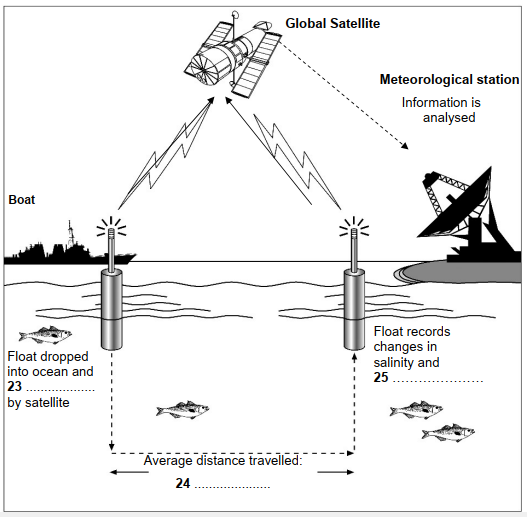
Q 21 – “cigars” is wrong.
Q 23 – “activated” is wrong.
Q 24 – “50 kilometer” is wrong.
- Always observe the word limit specified in the question.
- Write answers on the correct side of the answer sheet.
0