


IELTS WRITING TASK 2 TECHNIQUES
July 1,2025
root
IELTS WRITING TASK 2
- Understand the task
- Break the task into parts
- Methods, techniques and demonstration of methods and techniques
- Lots of practice
- Feedback, measure progress (give feedback on students’ performance and how to improve, give tests for students’ self assessment and teacher assessment)
In task 2, you are asked to write at least 250 words for a duration of 40 minutes.
There are 4 question types:
WRITING THE INTRODUCTION
A few ways to write a main paragraph
- When there is more than one idea in the paragraph, we can use Firstly, Secondly, Finally structure. This structure is good for talking about advantages, disadvantages, problems, solutions.
- When there is one idea explained in more detail, we can use Idea, Explain, Example structure. This structure is good for paragraph with one idea (a reason, an opinion…) and you have to explain it in more detail.
The main body paragraphs are the most important part of your writing task 2 essay. If you want to become an expert paragraph writer, practise the three types below.
The recommended paragraph contains five sentences, and each sentence should do a different job. Of course, you must meet the minimum word limit.
The issue with trying to write more is that you may lose coherence, make more mistakes or deviate from the task.
Paragraphs containing 3 ideas – Recommended structure
- Topic sentence: There are severalreasons / benefits / causes etc.
- First idea
- Example
- Second idea
- Third idea
* Where to put examples depends on what example you have and how it logically fits in.
Paragraphs containing 2 ideas – – Recommended structure
- Topic sentence: There are two main reasons / benefits / causes etc.
- First idea
- Explain / example
- Second idea
- Explain / example
Paragraphs containing 1 idea – – Recommended structure
- Topic sentence: The mainreason / benefit / cause etc.
- Explain
- Explain
- Example
- Explain
* Where to put examples depends on what example you have and how it logically fits in.
After you have had a plan, determine if the points to cover are separate points or just one point but explained in more detail. This helps you choose the appropriate paragraph structure.
These paragraph styles are not ‘rules’ and they are not the only ways to write good paragraphs. But they are effective, consistent, and are the structures we follow in our IELTS preparation courses.
The 3-idea paragraph can be the easiest type to write. However, it doesn’t give you the chance to develop your ideas in much detail.
The 1-idea paragraph can be the hardest to write. However, this type forces you to develop your idea in more detail, which could help you to get a higher score.
The 2-idea paragraph is a nice middle point. If you don’t have much time and want to master just one type of paragraph, choose this one.
If you want to get a band 7 or higher, you need to develop or extend your ideas. This means that you need to explain in more detail. You need to go deeper into at least one of your paragraph ideas.
Example 1:
Look at this question again:
Some people believe that unpaid community service should be a compulsory part of high school programmes.
To what extent do you agree or disagree.
Disagree position is chosen for this example
- Main paragraph 1
Disagree for several reasons:
- School timetable is full, no time for community service
- Students’ work in other subjects would be affected
- Teenagers might not want to do it (reluctant, no motivation).
3 separate ideas. So the topic sentence can be “disagree for several reasons”.
(Topic sentence) There are several reasons why I would argue against having compulsory community service for secondary school students. (First idea) Firstly, the school curriculum is already full with important academic subjects, such as Maths, Science and languages. (Example) For example, I remember having an extremely busy timetable when I was at high school, and it would not have been possible to add to it. (Second idea) Secondly, students’ performance in other subjects would be affected if valuable study time were taken by charity work or neighbourhood improvement schemes. (Third idea) Finally, I believe that teenage students would be reluctant to take part in any programme of obligatory work, and this could lead to poor motivation and even bad behaviour.
To summarise:
Try to write 5 sentences
- Topic sentence
- Firstly
- Secondly
- Finally
Add one more sentence to explain one of the points more clearly or add an example.
Remember:
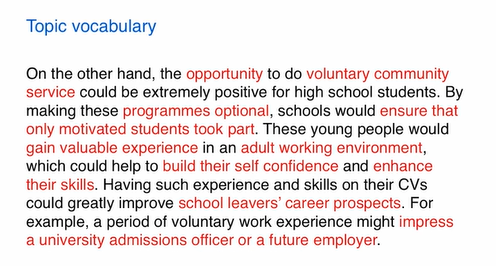
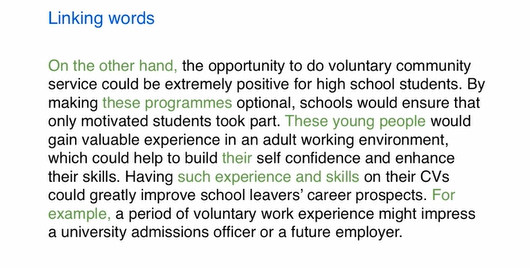
Linking words do not help your vocabulary score. Linking just needs to be clear and do the job and making your ideas easy to follow. If you use ‘foremost’ instead of ‘first’, it does not help you get a higher score. Examiners want to see “topic vocabulary”. Good topic vocabulary is the type you find in the example writing above.
- Main paragraph 2:
Plan of the second paragraph:
- Voluntary (not compulsory) community service is positive.
- Students more motivated if they can choose
- Gain work experience, self-confidence, skills
- Good for CVs, career, university admissions, employers.
(Topic sentence) On the other hand, the opportunity to do voluntary community service could be extremely positive for high school students. (Explain) By making these programmes optional, schools would ensure that only motivated students took part. (Explain) These young people would gain valuable experience in an adult working environment, which could help to build their self-confidence and enhance their skills. (Explain) Having such experience and skills on their CVs could greatly improve school leavers’ career prospects. (Example) For example, a period of voluntary work experience might impress a university admissions officer or a future employer.
This paragraph follows the Idea, Explain, Example structure.
HOW TO WRITE A CONCLUSION (Paraphrase the answer you gave in the introduction.)
Look at this example again:
Some people think that it is more effective for students to study in groups, while others believe that is it better for them to study alone.
Discuss both views and give your own opinion.
- Read and understand the question
- Highlight / underline key parts
Discuss both views – it is more effective to study in groups, it is more effective to study alone.
Give your own opinion
- Plan your essay structure (4 paragraph)
Sample plan:
- Introduction: topic + answer (introduce the topic and give a short and general answer).
- Main body paragraph
- Main body paragraph
- Conclusion: repeat answer
Introduction:
Topic: study in groups or alone
Answer: sometimes better alone, usually better in a group
Conclusion: both have benefits, but I prefer group study
Paragraph 2: benefits of studying alone
Paragraph 3: benefits of group study (my view)
- Plan ideas for the two main paragraphs
Brainstorm, note down any ideas you have, don’t write full sentences, don’t need to organize ideas at this stage yet.
Develop some key ideas in detail by asking ‘why’.
Think of examples to support your ideas.
Try to group related ideas (number them). Note that the numbers represent the sentences that you’re going to write.
You could spend 10 minutes for planning, following the 3 steps above.
- Read and understand the question
- Plan your essay structure
- Plan ideas for the 2 main paragraphs.
With 4 minutes for steps 1 & 2, 6 mins for step 3 (3 minutes for planning each main paragraph)
Paragraph 2: 3 minutes
Benefits of studying alone: why good?
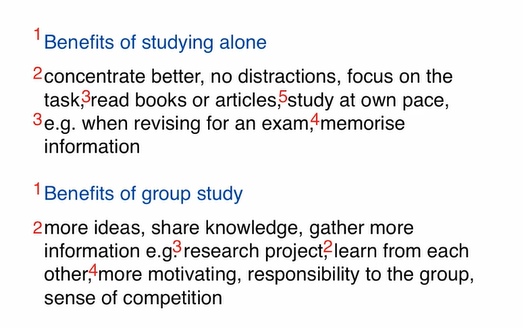
Concentrate better, no distractions, focus on the task, read books or articles, study at own pace, e.g. when revising for an exam, memorize information
Paragraph 3: 3 minutes
Benefits of group study:
More ideas, share knowledge, gather more information, e.g. research project, learn from each other, more motivating, responsibility to the group, sense of competition
Group related ideas and number them. The numbers represent the sentences that you’re going to write.
This is an example how the writer organizes the ideas brainstormed above:
*Number 1 is the idea for the topic sentence.
0