


6. PROCESS DIAGRAMS QUESTIONS - IELTS PAST PAPERS & SAMPLE PAPERSPROCESS DIAGRAMS QUESTIONS
July 1,2025
root
QUESTION PAPER 1 QUESTION PAPER 2 QUESTION PAPER 3 QUESTION PAPER 4 QUESTION PAPER 5 QUESTION PAPER 6 QUESTION PAPER 1How to use this material:
Model answer – The type we follow at TEACH
Reference answer – We use for reference
Candidate’s answer – We use to understand the Writing Band descriptors, for students to analyze and practice how to improve a piece of writing.
You should spend about 20 minutes on this task.
Write at least 150 words.
The diagrams below show the life cycle of the silkworm and the stages in the production of silk cloth.
Summarise the information by selecting and reporting the main features, and make comparisons where relevant.

(Cambridge 6 – TEST 3)
MODEL ANSWER:
The diagrams illustrate the stages in the life of a silkworm and the process of producing silk cloth.
There are four main stages in the life cycle of the silkworm, from eggs to adult moth. The process of silk cloth production involves six steps, from silkworm cocoon to silk material.
At the first stage in the life cycle of a silkworm, the moth lays its eggs. Around ten days later, silkworm larvae hatch from the eggs; these larvae feed on mulberry leaves. Then, after four to six weeks, the larvae become covered in silk thread, and it takes between three and eight days for a full cocoon to be produced.
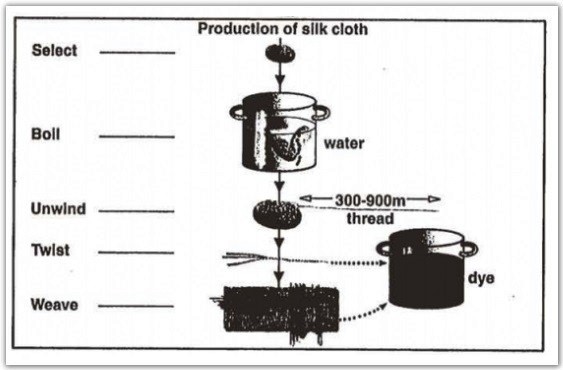
For silk cloth production, a cocoon is first selected and then boiled in water. After boiling, the silk thread that makes up the cocoon is unwound, and then several strands of thread are twisted together. At the fifth and sixth stages in the process, the thread can either be dyed and then woven into silk fabric, or it can be woven first and then dyed subsequently.
REFERENCE ANSWER:
The first diagram illustrates the silkworm’s life cycle and the second shows how silk cloth is produced. Overall, the life cycle of silkworms can be interrupted as they can be used to facilitate the production of silk cloth.
Regarding the life of silkworm, the silkworm moth lays eggs on mulberry leaves. After 10 days, the silkworm larvae hatch (breaks the eggs to come out) and use mulberry leaves as food source for themselves during 4 – 6 weeks. After this time, the larvae spend 3 – 8 days to spin (make) silk threads from cocoon to stay inside. From this stage, some cocoons will be used to produce silk cloth, if being selected. If they are not appropriate for silk cloth production, they go through 16-day-stage of developing and then fully developed silkworm moths hatch to begin their life cycle again.
The production of silk cloth begins with selected cocoons, then these are boiled in water. Thereafter, each boiled cocoon is unwound so that there is thread with 300 – 900 m in length produced. Afterwards, it is twisted or weaved and then dyed to complete silk cloth.
QUESTION PAPER 2The diagram below show the stages and equipment used in the cement-making process, and how cement is used to produce concrete for building purposes.
Summarise the information by selecting and reporting the main features, and make comparisons where relevant.

(Cambridge 8 – TEST 3)
MODEL ANSWER:
The first diagram illustrates the process of cement manufacture, and the second diagram shows the materials that go into the production of concrete.
It is clear that there are five stages in the production of cement, beginning with the input of raw materials and ending with bags of the finished product. To produce concrete, four different materials are mixed together.
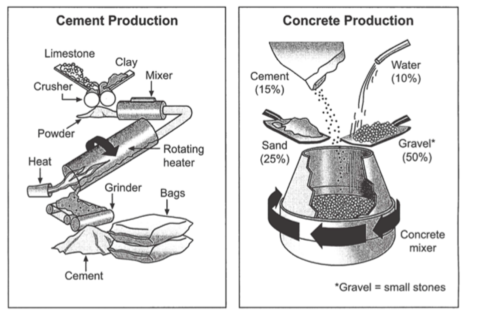
At the first stage in the production of cement, limestone and clay are crushed to form a powder. This powder is then mixed before it passes into a rotating heater. After heating, the resulting mixture is ground, and cement is produced. Finally, the cement is packaged in large bags.
Cement is one of the four raw materials that are used in the production of concrete, along with gravel, sand and water. To be exact, concrete consists of 50% gravel, 25% sand, 15% cement and 10% water. All four materials are blended together in a rotating machine called a concrete mixer.
A CANDIDATE’S ANSWER:
This is an answer written by a candidate who achieved a Band 6.5 score. Here is the examiner’s comment:
This answer presents the information in the two diagrams appropriately. The main difference between the two processes are identified in a clear summary, but other important features could be describe more fully. The organization of information is the strongest feature of this script. The description is well organized and there is a smooth progression across the whole answer that is achieved through good use of linkers and referencing phrases. A range of relevant vocabulary is used, although this is not wide and there are some less suitable word choices. There are a few mistakes in spelling, but these do not make the answer difficult to understand. A mix of sentence forms is used and there are some accurate examples of complex structures, but the many short, simple sentences tend to limit the range.
The diagrams show the processes and the equipment used to make cement, and how these are used to produce concrete for building purposes
The first step in the cement production is to introduce limestone clay. These materials pass through a crusher that produces a powder. Then this powder goes into a mixer. After this, the product passes to a rotating heater which works with heat. Afterwards, the mixture goes into a ginder where the cement comes out. At the end of the process, the cement is packed in bags
Referring to the concert production, the process begins with a combination of 15% cement, 10% water, 25% and sand 50% gravel. These four elements are introduced into a concrete mixer
As mentioned above, the concrete production take fewer steps that the cement production, however, it is necessary to use more materials than the latter process in order to obtain the final product
The last difference between both processes is that the concrete mixer does not work with heat.
QUESTION PAPER 3The diagram below shows how geothermal energy is used to produce electricity.
Summarise the information by selecting and reporting the main features, and make comparisons where relevant.

(Cambridge 12 – TEST 8)
A CANDIDATE’S ANSWER:
This is an answer written by a candidate who achieved a Band 6.0 score. Here is the examiner’s comment:
The candidate has provided a clear introduction and an overview of the key stages of the process. Each stage is identified and described, although there are some minor errors in the reporting of stage 5. There is room for expansion of the description of each stage, which could help to achieve a higher score. There is a clear overall progression, with each stage being signalled by appropriate markers [First I in order to I After that I At this point I Then, the final step I Finally]. These markers are adequate but a higher score might be achieved by varying their position in each sentence, rather than always placing them at the beginning. The range of vocabulary is adequate for the task and there are attempts to use more variety here [five general steps I connected I accumulated], though there are some examples of error in word choice [box I tank I a circle movements I a circular movement], in spelling [undergrownd I trough I conteiner sumary] and in word formation [condensered l condensed I gas I gaseous 1 ..trasladated I transferred? I condensering I condensing]. There is a mix of simple and complex sentence forms, including accurate use of passive forms. There are some errors [a/ an I who I what], but otherwise the level of accuracy is good. The same level of accuracy, over a wider range of sentence forms, would increase the score on Grammatical Range and Accuracy.
The diagram shows how electricity is produced by geothermal energy. There are five general steps in this process. First, in a big box connected underground, cold water is accumulated in order to be pumped down about 4.5 km.
After that, water is heated passing trough hot rocks called Geothermal zone and it is pumped up in order to be condensered in a big container. At this point, water is in a gas state and it is put in a turbine which moves it in a circle movements. Then, the final step is to use a generator in order to water be powered and energy can be produced. Finally energy is trasladated to a energy tower.
In summary, the gerthermal power plant is used to create energy in some steps: heating cold water by geothermal zone and condensering it in order to put it in a generator turbine which is who produces the energy to be used.
QUESTION PAPER 4The diagrams below show the life cycle of a species of large fish called the salmon.
Summarise the information by selecting and reporting the main features, and make comparisons where relevant.

(Cambridge 10 – TEST 4)
REFERENCE ANSWER:
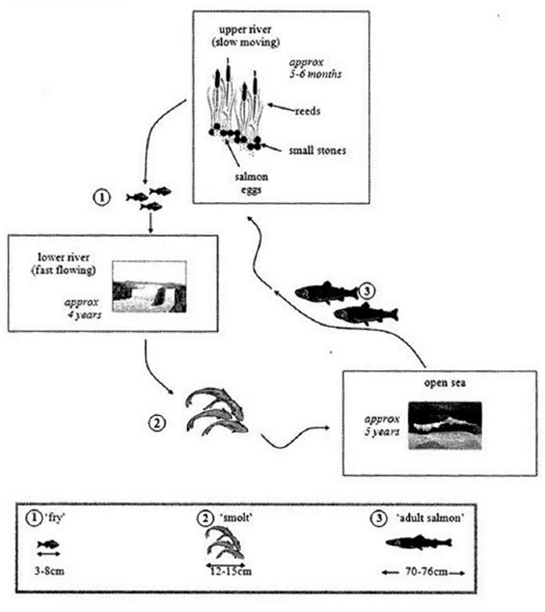
Salmon begin life as eggs on a pebbly riverbed, hidden among reeds in the slow moving upper reaches of a river. After five to six months the eggs hatch into ‘fry’. For approximately the next four years. these baby salmon will live in the lower, faster-flowing waters of their river. During this time they measure between three and eight centimetres in length.
By the time salmon reach twelve to fifteen centimetres, they are termed ‘smolt’, and at this time they migrate further downriver into the open sea. After five years at sea the salmon will have grown to adult size, which is between seventy and seventy-six centimetres. They then begin swimming back to their birthplace, where they will lay their eggs, and the cycle starts anew.
In summary, the salmon passes through three distinct physical stages as it grows to maturity. Each of these stages takes place in a very different aquatic location. It is noteworthy that the first two stages of this fish’s life occur in a freshwater environment, while the third stage is lived in saltwater.
QUESTION PAPER 5The diagram below shows how electricity is generated in a hydroelectric power station.
Summarise the information by selecting and reporting the main features, and make comparisons where relevant.

(Cambridge 14 – TEST 3)
MODEL ANSWER:
The diagram outlines the process of electricity production in a hydroelectric power station.
In general, the process begins when the water flows from the river into a high-level reservoir and ends with the transmission of electricity to the national grid. It is broadly distributed into day and night stages.
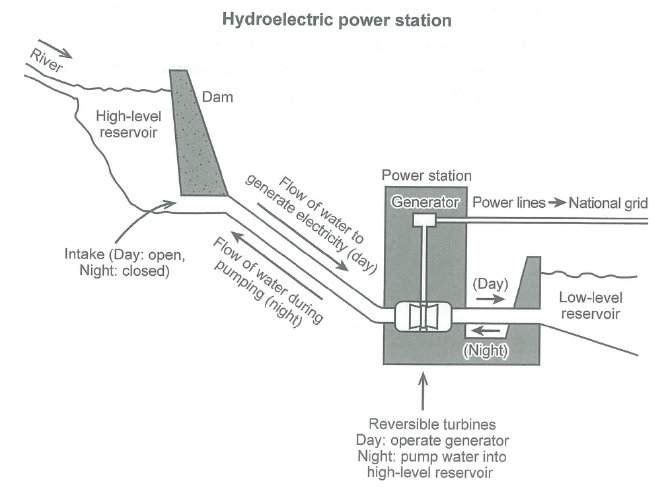
The day stage of the process involves channelling the river water into a high-level reservoir backed up by a dam. There is an intake area leading to the power station that opens during the day and closes at night. Water flows during the day to generate electricity through the power station turbines. The generated electricity is then sent to a national grid through power lines while the excess water runs to a low-level reservoir.
During the night stage, the water stored in the low-level reservoir is reverted to the power station and the turbines of the generator pump it back into the high-level reservoir which is closed during the night. The river water is stored at the upper level and later it flows down, starting the cycle again.
A CANDIDATE’S ANSWER:
This is an answer written by a candidate who achieved a Band 6.0 score. Here is the examiner’s comment:
The answer covers the key features of the process and provides an overview of this process in the final paragraph. The detail is not always clear, but the key features are adequately highlighted. Information is arranged coherently and there is a clear overall progression. Cohesive devices are used to signal different stages of the process [Then I On the other hand I So I In a conclusion I Meanwhile], and there is some use of pronouns for reference [It I which I that]. The range of vocabulary is adequate for the task [energy I operated by I transfer I mechanical ], in spite of some errors in word form [a reversed way] and spelling [differce heighth]. There is a mix of simple and complex sentence forms and grammatical control is generally adequate, though there are some errors in the use of articles.
A hydroelectric power station can generate electric power by using the energy of water flowing from high level to low level. It works different functions in day and night.
In the day time, water in the high-level reservoir go through the intake under the dam which is only open in day time. Then the water flow into the power station in which there is a generator. The generator is operated by a reversible turbines that can transfer the water flowing force to the mechanical force which is the power of the generator. The generated electricity then goes to the national grid through the power lines.
On the other hand in the night time, the power station works in a reversed way. It pumps water from the low-level reservoir to high-level reservoir to provide the enough water for day time’s work. The water is pumped by the same reversible turbines from low-level reservoir. So the power station actually consumes energy at night. But that is in order to generate more power in the day time.
In a conclusion, a hydroelectric power station can generate power is based on the difference height of water level. In day time, it uses the natural water energy. Meanwhile in the night, it transfers the water to create and store the energy for the next day.
QUESTION PAPER 6The diagram below shows how instant noodles are manufactured.
Summarise the information by selecting and reporting the main features, and make comparisons where relevant.

(Cambridge 15 – TEST 3)
A CANDIDATE’S ANSWER:
This is an answer written by a candidate who achieved a Band 6.5 score. Here is the examiner’s comment:
This response addresses the task fully and provides a description for each stage of the process, along with supporting details. A stronger overview would help to raise the overall score. Information is logically organised and the reader is guided through the answer by a range of cohesive devices [Moreover I In general I The first operation I Then I further I too I At this moment I After that I The seventh stage I The final part I Overall ]. There is also use of reference [this] and substitution to add variety to the description. There is some flexibility in the use of vocabulary [Labelling + sealing à lables I labels are added to the cups which are sealed] and there is good use of less common items [The substance I round-shaped figures I the product I packaging]. There is a variety of complex structures used and most of these are accurate: there is an error in line 6 [which a cut I which are cut].
The given scheme explains the process of instant noodles production. Moreover it reveals how this product appears on super market shelves. In general, there are eight stages of manufacturing before the final product is being delivered to the store.
The first operation consists of putting flour into storage silos. Then the flours is mixed with some other ingredients into dough in a special machine. The substance is further stretched into sheets which a cut into thin strips during the fourth stage. The following operation involves the strips too. At this moment the noodles are formed into discs. After that the round-shaped figures are cooked in oil and dried. The seventh stage consists of placing the product into cups and adding some vegetables and spices to it. The final part of production process is mainly about the packaging. At this moment freshly printed lables are added to the cups which are sealed after that. As soon as the product (instant noodles) is ready to leave the factory, it is shipped to a shopping facility.
Overall, it takes a considerably long time for a product to get to a supermarket.
Sources:
Cambridge IELTS
Nội dung mặc định bạn muốn chèn vào editorThe diagrams below show the life cycle of the silkworm and the stages in the production of silk cloth.
Summarise the information by selecting and reporting the main features, and make comparisons where relevant.
(Cambridge 6 – TEST 3)
MODEL ANSWER:
The diagrams illustrate the stages in the life of a silkworm and the process of producing silk cloth.
There are four main stages in the life cycle of the silkworm, from eggs to adult moth. The process of silk cloth production involves six steps, from silkworm cocoon to silk material.
At the first stage in the life cycle of a silkworm, the moth lays its eggs. Around ten days later, silkworm larvae hatch from the eggs; these larvae feed on mulberry leaves. Then, after four to six weeks, the larvae become covered in silk thread, and it takes between three and eight days for a full cocoon to be produced.
For silk cloth production, a cocoon is first selected and then boiled in water. After boiling, the silk thread that makes up the cocoon is unwound, and then several strands of thread are twisted together. At the fifth and sixth stages in the process, the thread can either be dyed and then woven into silk fabric, or it can be woven first and then dyed subsequently.
REFERENCE ANSWER:
The first diagram illustrates the silkworm’s life cycle and the second shows how silk cloth is produced. Overall, the life cycle of silkworms can be interrupted as they can be used to facilitate the production of silk cloth.
Regarding the life of silkworm, the silkworm moth lays eggs on mulberry leaves. After 10 days, the silkworm larvae hatch (breaks the eggs to come out) and use mulberry leaves as food source for themselves during 4 – 6 weeks. After this time, the larvae spend 3 – 8 days to spin (make) silk threads from cocoon to stay inside. From this stage, some cocoons will be used to produce silk cloth, if being selected. If they are not appropriate for silk cloth production, they go through 16-day-stage of developing and then fully developed silkworm moths hatch to begin their life cycle again.
The production of silk cloth begins with selected cocoons, then these are boiled in water. Thereafter, each boiled cocoon is unwound so that there is thread with 300 – 900 m in length produced. Afterwards, it is twisted or weaved and then dyed to complete silk cloth.
The diagram below show the stages and equipment used in the cement-making process, and how cement is used to produce concrete for building purposes.
Summarise the information by selecting and reporting the main features, and make comparisons where relevant.
(Cambridge 8 – TEST 3)
MODEL ANSWER:
The first diagram illustrates the process of cement manufacture, and the second diagram shows the materials that go into the production of concrete.
It is clear that there are five stages in the production of cement, beginning with the input of raw materials and ending with bags of the finished product. To produce concrete, four different materials are mixed together.
At the first stage in the production of cement, limestone and clay are crushed to form a powder. This powder is then mixed before it passes into a rotating heater. After heating, the resulting mixture is ground, and cement is produced. Finally, the cement is packaged in large bags.
Cement is one of the four raw materials that are used in the production of concrete, along with gravel, sand and water. To be exact, concrete consists of 50% gravel, 25% sand, 15% cement and 10% water. All four materials are blended together in a rotating machine called a concrete mixer.
A CANDIDATE’S ANSWER:
This is an answer written by a candidate who achieved a Band 6.5 score. Here is the examiner’s comment:
This answer presents the information in the two diagrams appropriately. The main difference between the two processes are identified in a clear summary, but other important features could be describe more fully. The organization of information is the strongest feature of this script. The description is well organized and there is a smooth progression across the whole answer that is achieved through good use of linkers and referencing phrases. A range of relevant vocabulary is used, although this is not wide and there are some less suitable word choices. There are a few mistakes in spelling, but these do not make the answer difficult to understand. A mix of sentence forms is used and there are some accurate examples of complex structures, but the many short, simple sentences tend to limit the range.
The diagrams show the processes and the equipment used to make cement, and how these are used to produce concrete for building purposes
The first step in the cement production is to introduce limestone clay. These materials pass through a crusher that produces a powder. Then this powder goes into a mixer. After this, the product passes to a rotating heater which works with heat. Afterwards, the mixture goes into a ginder where the cement comes out. At the end of the process, the cement is packed in bags
Referring to the concert production, the process begins with a combination of 15% cement, 10% water, 25% and sand 50% gravel. These four elements are introduced into a concrete mixer
As mentioned above, the concrete production take fewer steps that the cement production, however, it is necessary to use more materials than the latter process in order to obtain the final product
The last difference between both processes is that the concrete mixer does not work with heat.
The diagram below shows how geothermal energy is used to produce electricity.
Summarise the information by selecting and reporting the main features, and make comparisons where relevant.

(Cambridge 12 – TEST 8)
A CANDIDATE’S ANSWER:
This is an answer written by a candidate who achieved a Band 6.0 score. Here is the examiner’s comment:
The candidate has provided a clear introduction and an overview of the key stages of the process. Each stage is identified and described, although there are some minor errors in the reporting of stage 5. There is room for expansion of the description of each stage, which could help to achieve a higher score. There is a clear overall progression, with each stage being signalled by appropriate markers [First I in order to I After that I At this point I Then, the final step I Finally]. These markers are adequate but a higher score might be achieved by varying their position in each sentence, rather than always placing them at the beginning. The range of vocabulary is adequate for the task and there are attempts to use more variety here [five general steps I connected I accumulated], though there are some examples of error in word choice [box I tank I a circle movements I a circular movement], in spelling [undergrownd I trough I conteiner sumary] and in word formation [condensered l condensed I gas I gaseous 1 ..trasladated I transferred? I condensering I condensing]. There is a mix of simple and complex sentence forms, including accurate use of passive forms. There are some errors [a/ an I who I what], but otherwise the level of accuracy is good. The same level of accuracy, over a wider range of sentence forms, would increase the score on Grammatical Range and Accuracy.
The diagram shows how electricity is produced by geothermal energy. There are five general steps in this process. First, in a big box connected underground, cold water is accumulated in order to be pumped down about 4.5 km.
After that, water is heated passing trough hot rocks called Geothermal zone and it is pumped up in order to be condensered in a big container. At this point, water is in a gas state and it is put in a turbine which moves it in a circle movements. Then, the final step is to use a generator in order to water be powered and energy can be produced. Finally energy is trasladated to a energy tower.
In summary, the gerthermal power plant is used to create energy in some steps: heating cold water by geothermal zone and condensering it in order to put it in a generator turbine which is who produces the energy to be used.
The diagrams below show the life cycle of a species of large fish called the salmon.
Summarise the information by selecting and reporting the main features, and make comparisons where relevant.
(Cambridge 10 – TEST 4)
REFERENCE ANSWER:
Salmon begin life as eggs on a pebbly riverbed, hidden among reeds in the slow moving upper reaches of a river. After five to six months the eggs hatch into ‘fry’. For approximately the next four years. these baby salmon will live in the lower, faster-flowing waters of their river. During this time they measure between three and eight centimetres in length.
By the time salmon reach twelve to fifteen centimetres, they are termed ‘smolt’, and at this time they migrate further downriver into the open sea. After five years at sea the salmon will have grown to adult size, which is between seventy and seventy-six centimetres. They then begin swimming back to their birthplace, where they will lay their eggs, and the cycle starts anew.
In summary, the salmon passes through three distinct physical stages as it grows to maturity. Each of these stages takes place in a very different aquatic location. It is noteworthy that the first two stages of this fish’s life occur in a freshwater environment, while the third stage is lived in saltwater.
The diagram below shows how electricity is generated in a hydroelectric power station.
Summarise the information by selecting and reporting the main features, and make comparisons where relevant.
(Cambridge 14 – TEST 3)
MODEL ANSWER:
The diagram outlines the process of electricity production in a hydroelectric power station.
In general, the process begins when the water flows from the river into a high-level reservoir and ends with the transmission of electricity to the national grid. It is broadly distributed into day and night stages.
The day stage of the process involves channelling the river water into a high-level reservoir backed up by a dam. There is an intake area leading to the power station that opens during the day and closes at night. Water flows during the day to generate electricity through the power station turbines. The generated electricity is then sent to a national grid through power lines while the excess water runs to a low-level reservoir.
During the night stage, the water stored in the low-level reservoir is reverted to the power station and the turbines of the generator pump it back into the high-level reservoir which is closed during the night. The river water is stored at the upper level and later it flows down, starting the cycle again.
A CANDIDATE’S ANSWER:
This is an answer written by a candidate who achieved a Band 6.0 score. Here is the examiner’s comment:
The answer covers the key features of the process and provides an overview of this process in the final paragraph. The detail is not always clear, but the key features are adequately highlighted. Information is arranged coherently and there is a clear overall progression. Cohesive devices are used to signal different stages of the process [Then I On the other hand I So I In a conclusion I Meanwhile], and there is some use of pronouns for reference [It I which I that]. The range of vocabulary is adequate for the task [energy I operated by I transfer I mechanical ], in spite of some errors in word form [a reversed way] and spelling [differce heighth]. There is a mix of simple and complex sentence forms and grammatical control is generally adequate, though there are some errors in the use of articles.
A hydroelectric power station can generate electric power by using the energy of water flowing from high level to low level. It works different functions in day and night.
In the day time, water in the high-level reservoir go through the intake under the dam which is only open in day time. Then the water flow into the power station in which there is a generator. The generator is operated by a reversible turbines that can transfer the water flowing force to the mechanical force which is the power of the generator. The generated electricity then goes to the national grid through the power lines.
On the other hand in the night time, the power station works in a reversed way. It pumps water from the low-level reservoir to high-level reservoir to provide the enough water for day time’s work. The water is pumped by the same reversible turbines from low-level reservoir. So the power station actually consumes energy at night. But that is in order to generate more power in the day time.
In a conclusion, a hydroelectric power station can generate power is based on the difference height of water level. In day time, it uses the natural water energy. Meanwhile in the night, it transfers the water to create and store the energy for the next day.
The diagram below shows how instant noodles are manufactured.
Summarise the information by selecting and reporting the main features, and make comparisons where relevant.

(Cambridge 15 – TEST 3)
A CANDIDATE’S ANSWER:
This is an answer written by a candidate who achieved a Band 6.5 score. Here is the examiner’s comment:
This response addresses the task fully and provides a description for each stage of the process, along with supporting details. A stronger overview would help to raise the overall score. Information is logically organised and the reader is guided through the answer by a range of cohesive devices [Moreover I In general I The first operation I Then I further I too I At this moment I After that I The seventh stage I The final part I Overall ]. There is also use of reference [this] and substitution to add variety to the description. There is some flexibility in the use of vocabulary [Labelling + sealing à lables I labels are added to the cups which are sealed] and there is good use of less common items [The substance I round-shaped figures I the product I packaging]. There is a variety of complex structures used and most of these are accurate: there is an error in line 6 [which a cut I which are cut].
The given scheme explains the process of instant noodles production. Moreover it reveals how this product appears on super market shelves. In general, there are eight stages of manufacturing before the final product is being delivered to the store.
The first operation consists of putting flour into storage silos. Then the flours is mixed with some other ingredients into dough in a special machine. The substance is further stretched into sheets which a cut into thin strips during the fourth stage. The following operation involves the strips too. At this moment the noodles are formed into discs. After that the round-shaped figures are cooked in oil and dried. The seventh stage consists of placing the product into cups and adding some vegetables and spices to it. The final part of production process is mainly about the packaging. At this moment freshly printed lables are added to the cups which are sealed after that. As soon as the product (instant noodles) is ready to leave the factory, it is shipped to a shopping facility.
Overall, it takes a considerably long time for a product to get to a supermarket.
0